Celadonsoft Logo
//

Embedded Finance Examples in SaaS, Marketplaces, and B2B Platforms

31 August 2026Author: Alexei Falco2467 Views

Embedded finance use cases show how payments, accounts, lending, insurance, and payouts become part of non-financial product workflows SaaS platforms integrate billing и payments, marketplaces utilize seller payouts and accounts, while B2B platforms use procurement payments and financing.

They may look similar, but each workflow has different requirements for integrations, balances, reconciliation, and compliance. And that’s the reason why we should evaluate embedded finance use cases not by the financial feature checklist, but by how those features actually power the core product.

Content
  1. Why examples matter more than definitions in buyer research
  2. Embedded finance examples by product category
  3. What changes across embedded finance use cases
  4. How to evaluate whether a use case is worth building
  5. From example to implementation roadmap
  6. Embedded finance experience across real products

Why examples matter more than definitions in buyer research

An embedded finance example is useful only when viewed as a complete business scenario. The same payment, account, or lending capability can require a different operating model depending on where it appears.

When comparing use cases, evaluate:

  • what user or operational problem the capability solves;
  • how it connects to the product’s core workflow;
  • what economic value it may create;
  • which provider and platform responsibilities it introduces;
  • what onboarding, integration, reconciliation, and support processes it requires.

Embedded finance examples by product category

SaaS billing and payments

One of the most straightforward examples is to embed payments directly into the SaaS product.

Imagine a business operations platform. The user creates invoices, manages clients, and tracks outstanding debts. Adding payments allows them to accept payments, track transaction status, and manage refunds without switching to a separate payment service.

Embedded finance for SaaS does not always require accounts or a complete banking product. It may begin with a payment workflow connected to existing billing, customer, and accounting data.

Marketplace seller payouts

A marketplace is one of the most distinctive examples of embedded finance because the business model already involves the fund movement between multiple parties. 

The buyer pays the marketplace. The platform can withhold its commission. After that, the money may be distributed among the sellers and potentially other participants. The embedded payments examples cover checkout, seller onboarding, balances, payouts, and transaction tracking.

Sellers may view available and pending balances, transaction history, and payout status. The platform must be able to explain which transactions, fees, refunds, and settlement events produced each amount.

The more complex the marketplace is, the more important reconciliation between internal records and external payment or banking providers' data becomes.

Celadonsoft delivery example: We developed a B2B marketplace with pre-funded vendor wallets, commission deductions, and admin-controlled transaction rules.

B2B procurement and financing

In B2B products, embedded finance often appears where a financial transaction is already part of the business process. 

A procurement platform allows a company to find a supplier, place an order, and pay the invoice directly inside the system.

The next level is financing. If the platform holds relevant purchase-order, invoice, and transaction data, subject to appropriate permissions, it may also present financing at the point where a company needs working capital. 

That’s one of the most widely spread embedded lending examples. The platform does not necessarily become the lender. A regulated lending partner may handle underwriting, funding, and repayment, while the product incorporates eligibility, the offer, application status, and resulting actions into the customer journey.

HR and earned wage access

HR and payroll platforms can use embedded finance to connect financial capabilities with existing employer and employee workflows. One example is earned wage access, where an employee can access already earned funds before the standard payday. 

The product must connect the financial workflow with payroll data, employee eligibility, employer rules, fund movement, and subsequent payroll settlement. Other use cases may include payroll-related payments, employee accounts, benefits funding, or insurance services.

Celadonsoft delivery example: We developed an ICHRA administration platform connecting employee enrollment, employer contributions, premium funding, payment processing, and operational workflows.

Real estate and rent workflows

Embedded finance may create value in real estate products when payments and financial records need to remain connected to leases, properties, tenants, and owners.

Property management software can allow tenants to pay rent directly inside the platform, and property owners to receive payouts and track income. Security deposit workflows, recurring payments, or other financial operations can be added on top.

The value here goes beyond just payment convenience. The financial function is connected with lease data, tenant accounts, property records, and reporting. Therefore, the platform must maintain a consistent state of financial and non-financial data. It must differentiate which invoice belongs to which contract and whether the corresponding payment was actually completed. 

Travel and insurance

Nothing pairs with embedded finance better than booking services. 

While booking a trip, the user can get an insurance offer directly inside the booking flow. There is no need to look for an insurance company separately and re-enter trip data. 

For the platform, this creates an additional financial product closely tied to the main customer journey. It is important to consider the policy lifecycle alongside payment processing. Product design must account for the policy lifecycle, including product selection, premium calculation, purchase confirmation, booking changes, cancellation, and handoff to the insurer for provider-owned processes. 


Which embedded finance use case fits your product?

Compare the business value, provider model, financial workflows, integration scope, and operational responsibilities before committing to implementation.

asc

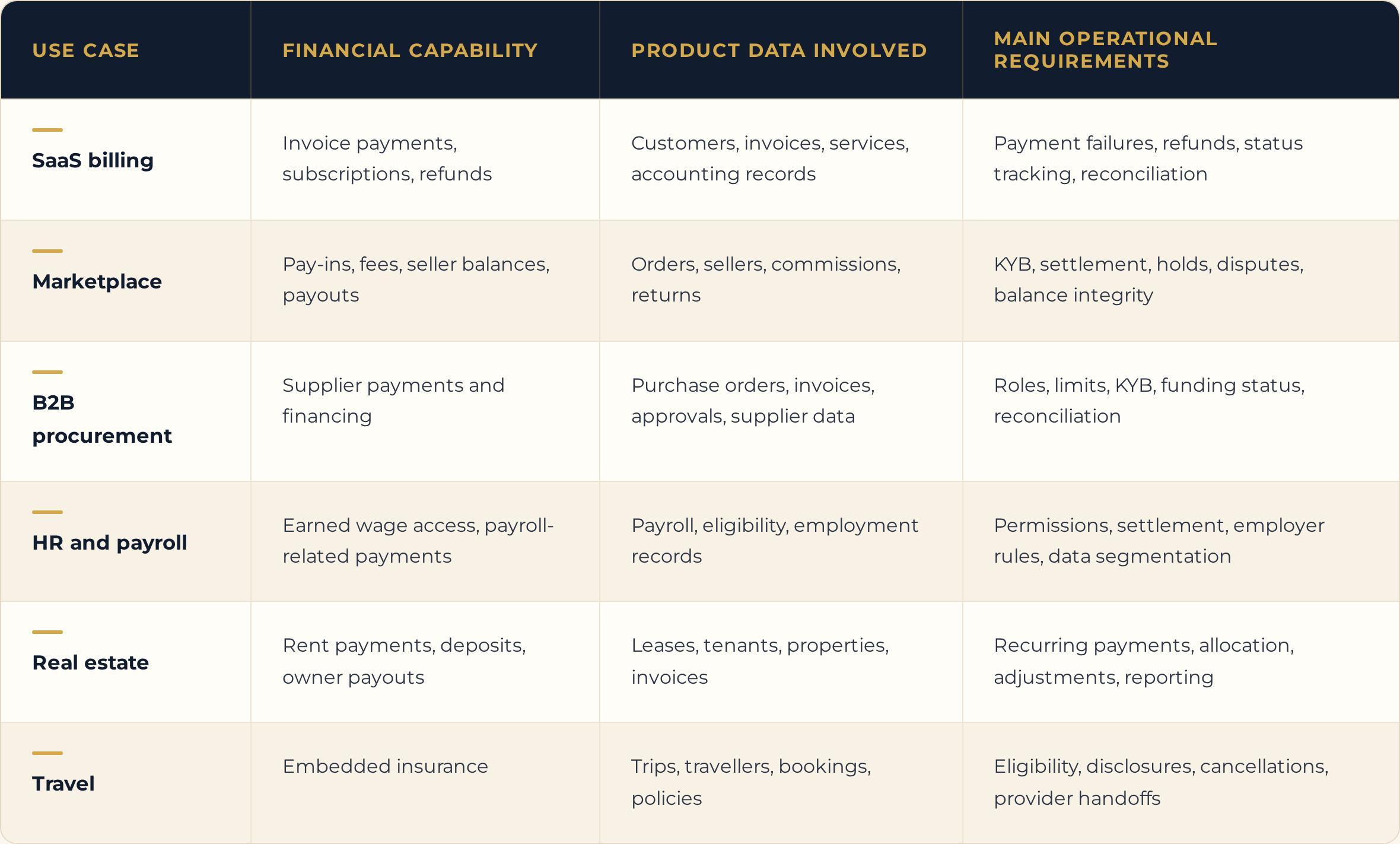
What changes across embedded finance use cases

The same financial capability can create different architectural and operational requirements depending on the product in which it appears.

embedded-finance-usecases-table_v2.png

Across all use cases, teams still need to define:

  • the authoritative source for each financial state;
  • provider and platform responsibilities;
  • onboarding and verification requirements;
  • transaction states and failure handling;
  • reconciliation and exception management;
  • operational access for support and finance teams.

For a deeper technical explanation, see What Is Embedded Finance? Use Cases, Models, and Architecture. For provider connectivity, webhooks, retries, idempotency, and state synchronization, explore our banking API integration services.

How to evaluate whether a use case is worth building

Not every embedded finance feature is worth implementing. Before choosing any scenario, it is wise to evaluate it in terms of customer demand, business model, and operational responsibility.

Business model

The very first question you have to raise is ‘What financial function will create an economic value for the product?’ For different products, the answers may vary. It may be a transaction fee, revenue share with a financial provider, an additional subscription tier, or retention increase due to a more complex workflow.

Sometimes the financial function doesn’t generate a separate revenue stream, but makes the product itself much more valuable. For example, a marketplace may add seller payouts not for the direct commissions, but from the need to retain the vendors with a convenient payout workflow.

If the business effect can’t be tied to the revenue, retention, or a significant workflow improvement, it is wise to rethink the necessity of the embedded finance.

Operational complexity

Another question is “What operating model will the platform need after launch?” A payment workflow may require support for refunds, failed payments, disputes, monitoring, and reconciliation. Marketplace payouts add seller onboarding, balances, settlement, and reconciliation. Financing will require additional eligibility and lending partner interactions.

The more processes are connected, the more operational work the team will face. Monitoring, exception handling, support, and financial reporting.

Each use case should be evaluated not only by the appeal it may have for the users, but also by the constant operational complexity its implementation may introduce.

Regulatory exposure

Financial features may create additional regulatory requirements, though their scale depends on the exact model, geography, and the chosen partner model.

Before the implementation begins, it is crucial to determine what regulated activities the provider executes, what проверки are necessary for the users, and what data the platform should process on its own. 

IIt is crucial to understand that an external provider does not automatically exempt a product from any regulatory responsibilities. The boundaries of responsibility depend on each model and the agreements between the parties.

What to build and what to integrate

Last but not least: What makes sense to build in-house, and what is better to get through a specialized partner?

Usually there is no need to independently create the banking or the payment infrastructure if the chosen provider may give access to the necessary capability. But the product logic, orchestration, data model, and customer experience have to be handled separately.

For those reasons, it’s wise to make a build-vs-partner decision independently for each layer. You have to determine what the financial provider should do, the platform’s area of responsibility, and where the separate engineering layer is needed.

From example to implementation roadmap

When the necessary use case is chosen, the following step is to turn the business scenario into a straightforward implementation plan.

Start by describing the main financial workflow. Who initiates the operation, what stages it goes through, what data is involved, and what systems should exchange the data. This allows you to determine the provider model and the necessary integrations set. Based on that information, the accounts, balances, ledger boundaries, onboarding, webhooks, reconciliation, and exception handling may be designed.

That approach allows you to determine the cost of the initial development, as well as how the financial function would act after the launch and during scaling. The implementation roadmap is especially important for a complex scenario. The product has to correctly account for money, process exceptions, reconcile records, and give the operations team clear control over financial processes.

If your use case requires multiple financial providers, complex workflows, or its own financial layer, fintech software development services may include designing an entire product or technical architecture. 


Embedded finance experience across real products

Celadonsoft has delivered financial workflows for marketplace wallets and commissions, mass payouts, employer-funded benefits, cross-border transactions, and Banking-as-a-Service products.

As an official Priority Passport engineering partner, our team also works with product-level capabilities across accounts and balances, payment and treasury workflows, banking integrations, reconciliation, and operational tooling.

This experience helps us evaluate embedded finance use cases as complete operating models—not isolated financial features.

Our co-founder and CEO, has not just a thumb in business processes. He also loves to write. His entrepreneurship and management experience allows him to create content of high value for the customers and the blog readers.

Get Our Newsletter

We won’t spam you. Pinky promise.

Get in Touch

Attach file
Offices

USA

2807 N Parham Rd, Ste 320, Henrico, VA

+19295905986

Portugal

Av. Engenheiro Duarte Pacheco 1250, Lisbon

Poland

Ul. Humanska 8, Warszawa

UAE

Hamsah A, Al Karama, Office 21/02, Dubai

© Celadonsoft. All Rights Reserved. 2026

Privacy Policy