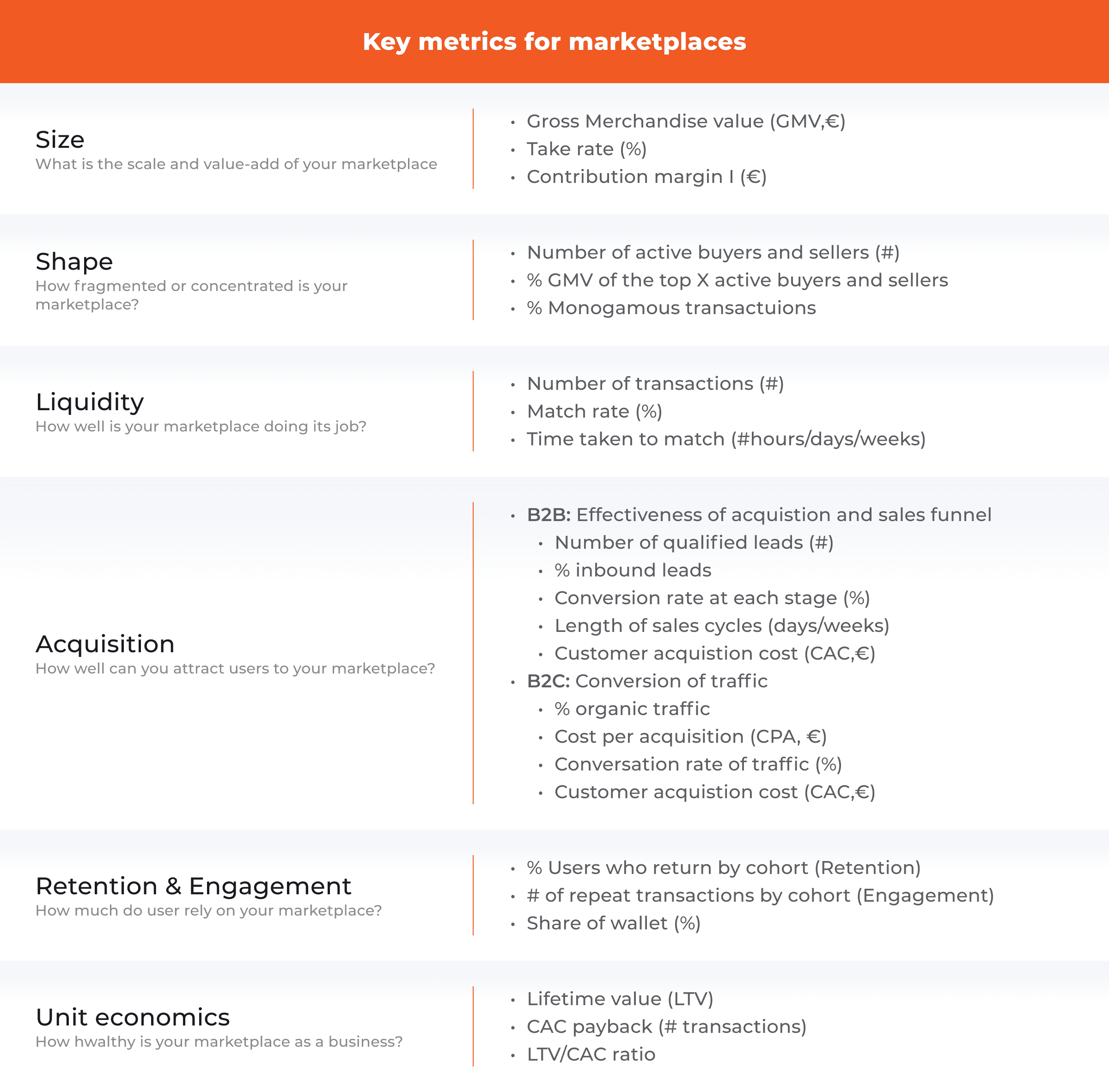
Other Important Marketplace Metrics
Marketing Customer Conversion Funnel
Conversion is the movement from one stage to another or a targeted action. Usually, the crucial conversion is the way that newcomers go through to purchase.
It's common to view the conversion from each step to the next. This is called a conversion funnel.
The customer conversion funnel includes several stages of decision-making:
I. Awareness Stage
A person simply looks for an item by using a search engine or navigates through the categories.
II. Consideration Stage
A customer may view some of the listings. If the goods and services aren’t the items they were looking for, they can go back to the search. Once the required listing is found, they go to the next stage.
III. Decision Stage
The visitor has viewed the options, and is ready to decide and click the “buy” button.
The funnel provides data on how things are going in your marketplace. It aids to detect the shortcomings where the users churn. Analyzing the conversion funnel, you can figure out what’s to be fine-tuned and pick the area to buckle down.
If the funnel shows a low visit rate, you should go the extra mile in user acquisition. The high bounce rate reveals an improper acquisition approach. Landing page enhancement or core value proposition fine-tune may become a solution.
Liquidity issues are seen when the users don’t bounce but don’t make their way up to the purchase. To solve this problem, you may narrow the marketplace niche or bump up the number of suppliers.
Stucking on the awareness stage, i.e., going through numerous listings without clicking the “buy” signals that quality optimization or fee reconsideration are required.
If a client has concluded on buying but is not going for payment, it’s time to review the transaction flow.
Retention & Engagement
Retention & Engagement are the online marketplace metrics illustrating how many users entrust your marketplace.
Retention is a cohort-based value that indicates the frequency of returns. For example, 12 customers made their first transaction in April. In May, 6 of them returned to transact again. And in June, 3 of them made a purchase. One-month retention is 50%, and two-month retention is 25%. Retention analysis helps to define what impacts the retention rate and purify the strategy to ensure higher retention.
Engagement shows how many times a retained customer repeats transactions by a certain time in their lifetime. To calculate engagement, cohort analyses are used, too.
As an online business entrepreneur, you would love your customers to return to transact and, by doing so, to make your marketplace to be the one where a specific category is shopped. In the beginning, the retention and engagement will be evened. But in the course of growth, the engagement is hoped to prevail.