



Do apps make money? No ifs, ands, or buts about it! How much money can you make off an app? With a staggering number of over 4.8m apps available for download on platforms such as the App Store and Google Play, there is substantial earning potential. However, it is crucial to recognize that only a small fraction of these apps manage to succeed in generating income for their owners and developers.
Creating a profitable app involves considering numerous variables and factors. It's crucial to thoroughly assess the market, competition, target audience, and monetization strategies before diving into app development. Additionally, it's worth mentioning from the start that if the sole motivation is to earn money by creating an app, it might be beneficial to reassess the approach.
Related: How Much Does it Cost to Develop an App
Indeed, successful apps often inspire developers to aspire to create something similar. However, let's face reality: duplicating another Instagram or Uber is highly unlikely. Prior to diving into app development, there are several essential steps to take, and one of the most crucial is to shift the focus from the apps themselves to the specific features that contribute to their popularity.
To begin with, it's essential to establish a general concept and vision for the app you intend to create. Once you have a clear idea, other questions arise, such as the cost to design an app and how to monetize it upon release. The answer to these questions is complex; Diverse variables determine it, including the niche, platform, and chosen monetization strategy. In due course, we will delve into how these factors influence the income potential of an app.
Developers can boost their chances of making a distinctive and lucrative application by comprehending the fundamental concepts and scrutinizing successful elements, even if it is hardly likely to follow in the commercial success of Instagram or Uber.
- Platforms and Potential Earnings: Unraveling the Influence
- What Are the Types of Revenue Models?
- How Much Money Can You Make by Creating an App of a Certain Category?
- Is it Profitable to Develop Apps for Other Smart Devices?
- Key Takeaways
Platforms and Potential Earnings: Unraveling the Influence
The platform decision has a huge impact on an app's probable revenue, as it directly influences the marketing strategy and the likelihood of user purchases. The market share and popularity of a platform play a crucial role. Currently, iOS holds approximately 27% of the global market, while Android dominates with nearly 73%. However, it's important to note that these statistics may only apply sometimes across the world. When examining each region individually, the landscape can vary considerably.
For instance, preferences differ among countries and regions. Users in the USA, Canada, Australia, Japan, Great Britain, and Scandinavian countries tend to favor iOS, whereas those in Eastern Europe, certain Western European countries, South America, Africa, and most Asian countries lean towards Android devices. Consequently, when developing an app, considering regional preferences becomes highly significant. If you begin your project with an Android app, it may be necessary to convert the Android app to iOS to tap into the user base of iOS devices and, hence, make money from an app running on both OS.
To maximize revenue potential, it is essential to take note of regional preferences and target specific areas accordingly. According to data from Sensor Tower regarding the App Store, significant growth is anticipated in Africa, Latin America, and Europe. Therefore, if you are focusing on iOS app development services, consider these regions as your target markets.
In summary, to regional preferences become vital factors in determining how much money one can earn with an app.
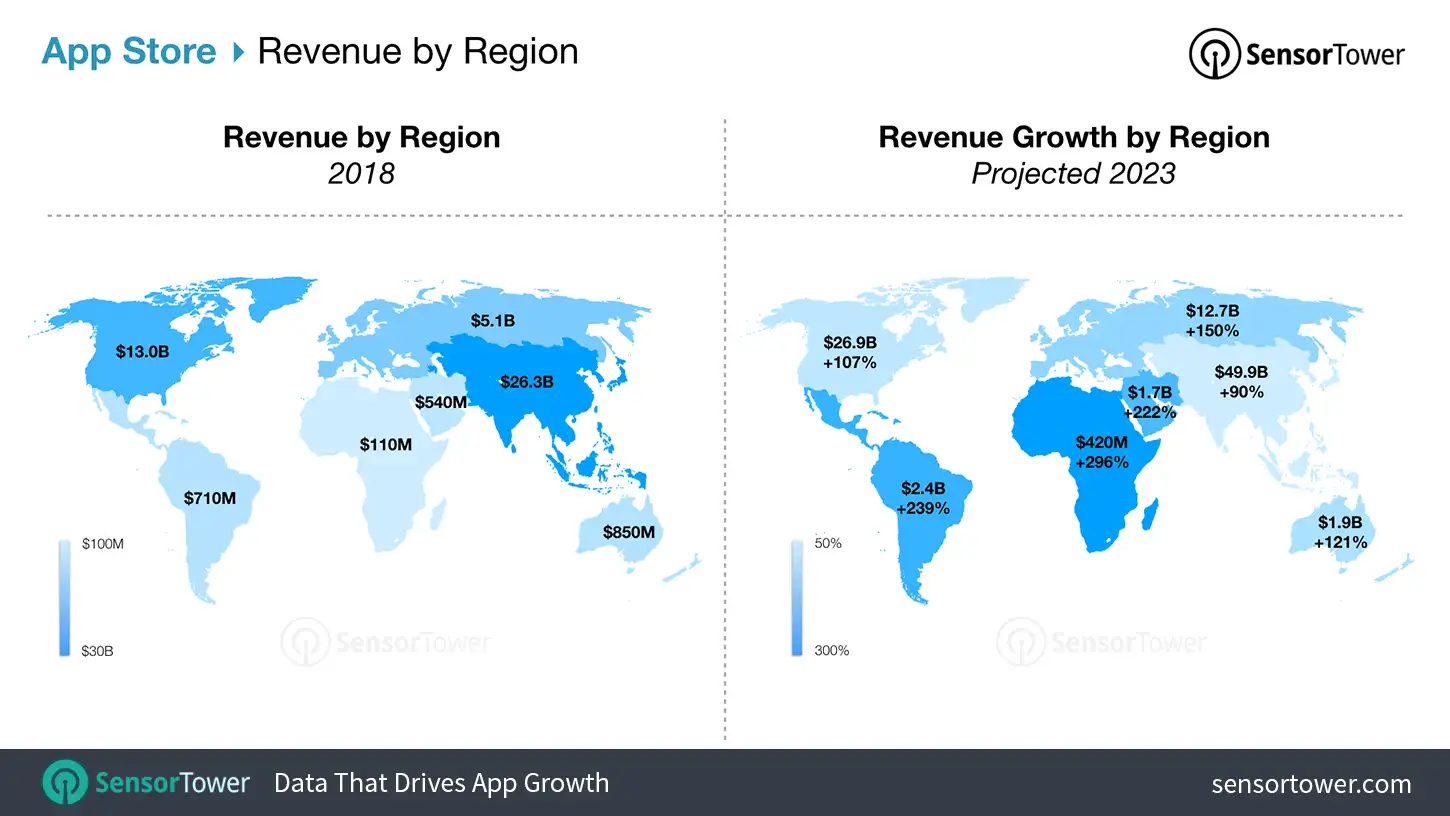
App Store Revenue by Region. Source: Sensor Tower
The aforementioned data highlights that the Asian region exhibits the lowest overall app revenue growth. However, revenue predictions are just one aspect to consider. Another crucial factor is the purchasing power of users, specifically comparing Android and Apple users. It is evident that Apple users generally possess higher purchasing power, spending approximately twice as much money in app stores compared to Android users.
Nevertheless, it's important to remember that these statistics are initially mere numbers until they are translated into actual revenue. Taking into account the figures mentioned earlier, both iOS and Android apps are projected to experience the lowest overall app revenue growth in Asia. The most recent data indicates that the combined income generated by mobile apps in the first half of 2021 reached approximately $50.1 billion. Out of this total, iOS apps accounted for $32.8 billion, while Android apps contributed $17.3 billion. Currently, there exists a gap between the two, but according to predictions, this gap is expected to gradually diminish over time.
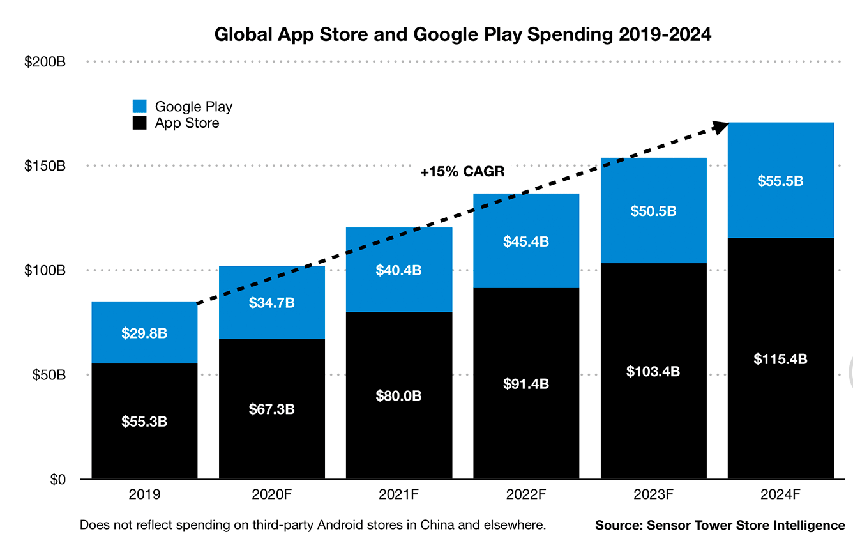
App Revenue Forecast, 2019-2024. Source: Sensor Tower
How much money can you make creating an app? Selecting the right platform is a crucial factor that influences app revenue.
While it may seem that the Apple App Store lags behind the Google Play Market, is the situation truly unfavorable for the Android market? Let's consider another piece of information: during Q4 of 2022, the App Store witnessed around 8.1 billion app installs, whereas Google Play recorded an astounding 8.1 billion installs. This indicates that, overall, more users tend to download apps from Google Play.
In summary, Apple has the advantage of attracting users with greater purchasing power, leading to more purchases. On the other hand, Google provides wider market coverage opportunities and a higher volume of app downloads. Therefore, the revenue potential of an app depends on making a wise platform choice that aligns with your specific goals and target audience.
So, How much money can you make creating an app? It is crucial to evaluate the above-mentioned factors and consider your objectives when deciding which platform to focus on, as it can significantly impact the success and revenue generation of your app.
What Are the Types of Revenue Models?
Choosing the right monetization strategy is crucial for generating income from your app. The good news is that there's no need to reinvent the wheel since numerous monetization models have already been described and implemented. With millions of apps currently in operation, a wealth of information exists regarding these models and how to effectively implement them.
To start, you can examine success stories from different brands that have utilized various monetization strategies. By studying their experiences, you can gain insights and inspiration for your own project. Once you feel confident with these well-known and tested models, you can explore different approaches and even experiment with combining them.
To provide clarity, monetization models can be classified into three main groups:
- Apps that are available for free to users, aptly named free apps, generate revenue through alternative means such as in-app advertisements, sponsorships, or partnerships.
- The freemium model, which is widely popular, offers partially free apps. These apps can be downloaded without any cost, but certain features or functionalities are restricted. To unlock the full capabilities, users have the choice to make a payment or donate.
- On the other hand, paid apps require an upfront purchase before users can download them. Some paid apps may offer a trial period where users can try the app for free, and then a fee is necessary to continue using it.
Now that we have briefly outlined the payment methods let's delve deeper into how these strategies can be used to generate income from your app.
#1. Free Apps
One ordinary misconception about free apps is that they don't generate revenue. However, that's not the case. How much money do you make from an app that is free to download? Well, it depends. Let's explore how free apps can actually make money. In two words, the answer is simple: in-app advertising or affiliate marketing.
The app owner earns money through user interactions with the ads displayed within the app. It's important to note that free apps can yield significant profits from ads, but this is dependent on achieving a high number of downloads.
There are different types of affiliate marketing campaigns to consider. Here are a few examples:
Cost per click (CPC): The app owner earns money for each click made on the ad. However, it's crucial to understand that various factors influence the actual amount of money earned. Additionally, CPC campaigns often use a cost-per-mille (thousand) calculation strategy, as a single click alone may not be significant.
Cost per view (CPW): In this campaign, the more users watch the ad within the app, the more money is earned. This type of campaign typically involves video ads.
Cost per install (CPI): The app owner generates income when users install the app being promoted through the ad.
These are just a few of the available options, and one can always choose the most suitable format based on their preferences. However, it's important to note that this approach comes with a drawback. Continuous testing and analysis of ads are required, which often leads to frequent placement and format changes.
To maximize the revenue potential of free apps, it's essential to carefully select and optimize the advertising format and continually evaluate its performance.
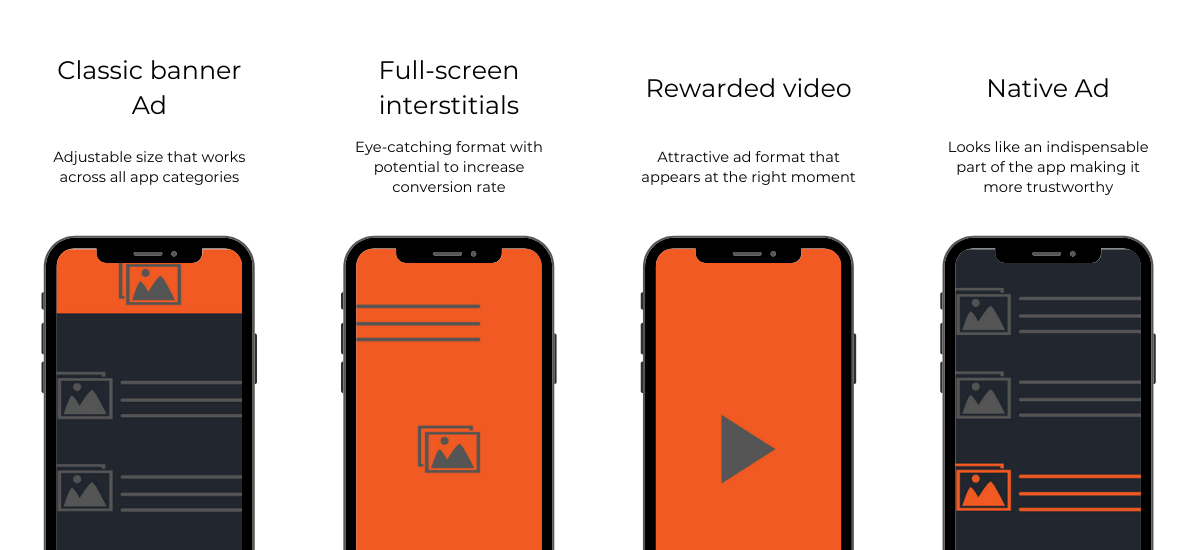
Ad Formats in Mobile Applications
#2. Partially Free Apps (Freemium)
If the concept of incorporating advertisements in your app doesn't resonate with you, there exists an alternative approach called the freemium model. This model is well-liked by users as it grants them the opportunity to enjoy the app and explore its content without requiring an upfront payment.
With the freemium model, users have the opportunity to make in-app purchases and pay for exclusive content or subscriptions that offer additional benefits. This approach is commonly employed by gaming apps, where they sell items such as extra lives, additional content, or essential in-game items.
However, it's essential to be aware of some significant drawbacks associated with this strategy before deciding to adopt it. In essence, users may not be interested in the extra content and instead choose to stick with the free content available.
To address this challenge, it is crucial to provide users with high-value content that convinces them to pay for the extras. This concept is often referred to as "converted loyalty," where loyal players and app users are converted into paying customers.
Another point to consider is that the revenue you receive may be different from the exact amount you set due to the shares taken by Google and Apple stores. While the share is not significant, it is still a portion that is divided. Typically, these stores claim around 15-30% of the sum the user pays. Consequently, you need to strike a balance between the price you set for the extra content and the customers' willingness to pay for it.
#3. Paid Apps
Users typically undergo a single change in their app journey, typically in the form of a one-time downloading fee. By paying for the app upfront, users gain access to all its features in one go. This approach is the oldest and most straightforward method, which dominated the early days of mobile app development.
However, with the ever-expanding array of choices available nowadays, users tend to gravitate towards free and freemium apps rather than paid ones. This shift has had a significant impact on app development as a whole. Consequently, an increasing number of newly created apps are incorporating these strategies right from the outset.
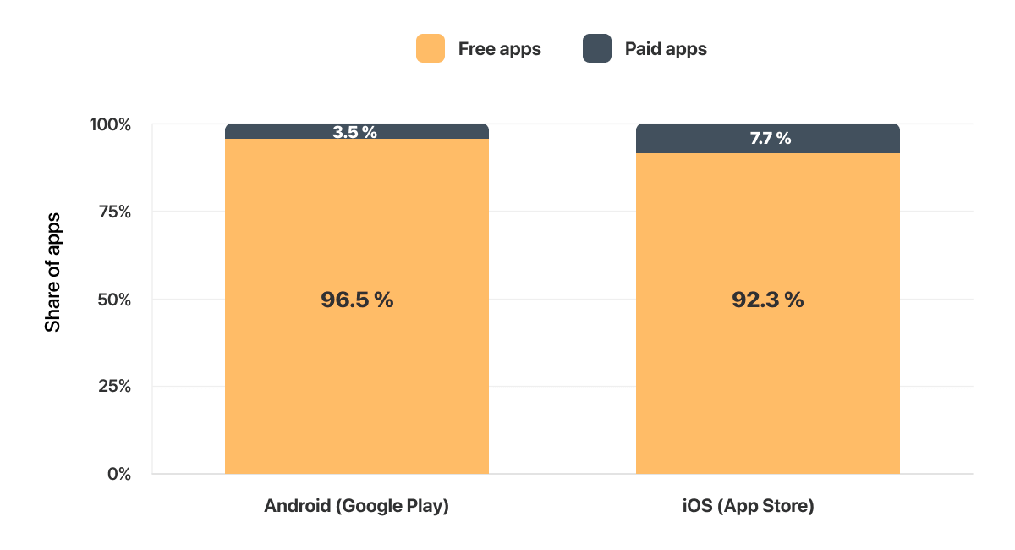
Free and Paid App Distribution for Android and iOS. Source: Statista
Paid apps suffer from a significant drawback: their revenue is dependent on acquiring new users who download the app. If you're willing to invest effort into steadily growing your user base, paid apps can be a viable solution. However, before you determine the pricing, it's crucial to carefully evaluate the pros and cons to strike the perfect balance.
Naturally, regardless of the strategy you opt for, doubts may arise. In 2020, consumers spent a total of $50.1 billion on Apple's App Store and Google Play Stores, but the primary source of revenue was not paid apps; instead, it stemmed from in-app subscriptions.
How Much Money Can You Make by Creating an App of a Certain Category?
The COVID-19 outbreak sparked a significant transformation in our lives, particularly regarding the role of mobile apps. With widespread home quarantine measures in place, smartphones became our primary tool for communication, connecting us not only with our immediate surroundings but also with the broader world. Statistical data indicates that mobile apps are poised for substantial growth in their influence over our daily lives in the coming years. A remarkable testament to this is the fact that people have already spent an astonishing trillion hours using "at-home" apps this year, and there seems to be no limit to this trend.
As a result of the pandemic, mobile apps have experienced a remarkable boost in revenue generation. By 2024, it is predicted that mobile applications will overtake games as the primary source of income, based on App Store statistics. The main source of revenue is predicted to be subscriptions, which are predicted to account for $58 billion of Apple's App Store's projected revenue by 2024.
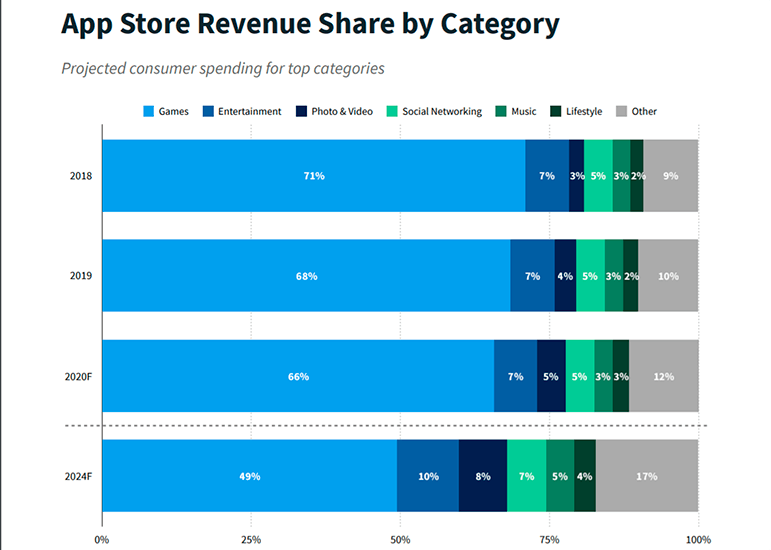
App Store Revenue Share by Category. Source: Sensor Tower
Google Play is expected to maintain its dominance in the realm of game apps for the foreseeable future. As projected, game apps are anticipated to make up approximately 74% of the market share on Google Play in 2024. In contrast, on the App Store, game apps are projected to account for around 49% of the market share during the same period.
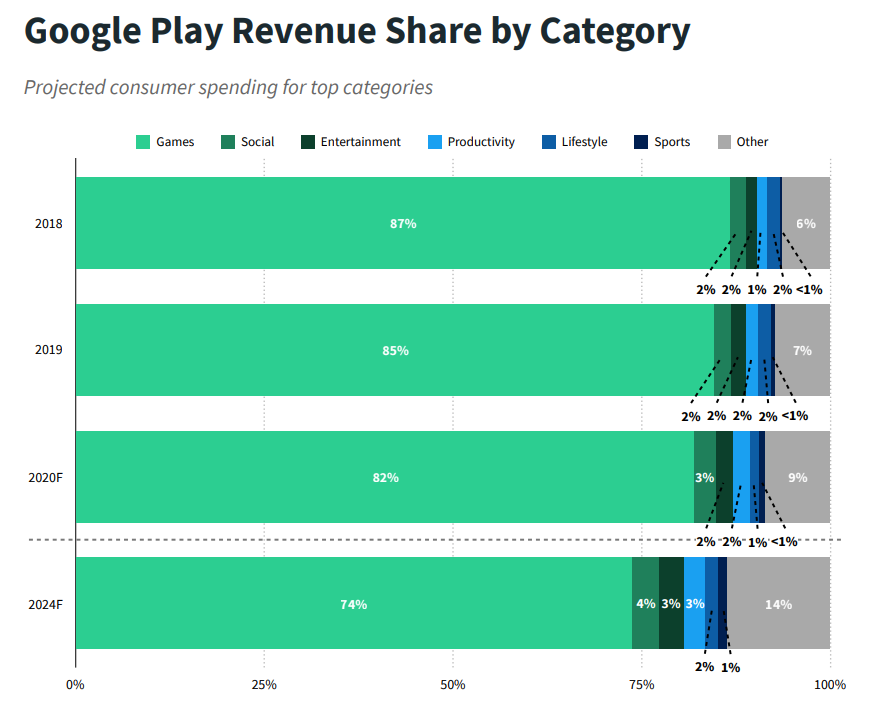
Google Play Revenue Share by Category. Source: Sensor Tower
Dating Apps
Dating apps are poised to experience a further surge in popularity, with projections indicating that they will reach a staggering US$2.98 billion in 2023. This demonstrates the remarkable growth and potential within the industry.
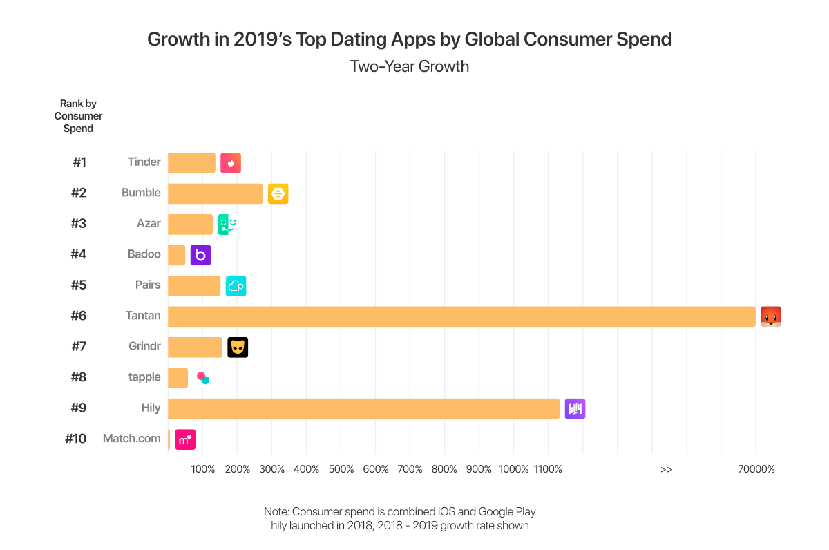
Global Consumer Spend in Dating Apps. Source: App Annie
Dating apps predominantly rely on in-app purchases as their monetization strategy, which has proven to be the most popular option for app owners. How much money do apps make? Let’s look at renowned examples.
One notable example is Tinder, a widely recognized app that serves as an excellent case study. With total revenue of $1.2 billion across both app stores, Tinder has emerged as the most profitable non-gaming app in the industry. While the app itself can be downloaded for free, it's the additional premium features offered on a subscription basis that have propelled its success.
Another top contender in the dating app market is Bumble, which holds the distinction of being the second-highest-grossing dating app. Bumble distinguishes itself by being female-friendly and prioritizing women's choices by allowing them to initiate conversations. It focuses on fostering serious relationships and boasts higher-quality profiles while also being considered more secure than Tinder. Although Bumble has a smaller user base in comparison, it follows a similar monetization strategy, further exemplifying its triumphant trajectory in the industry.
Related: How to Make a Dating App Like Tinder?
While dating apps commonly rely on in-app purchases as their primary monetization strategy, it's important to note that there are exceptions. MeetMe, for instance, employs a different approach by incorporating traditional advertisements. This allows users to access app features without the need for premium account options or subscription models. MeetMe even offers users a choice between regular ads and video ads. Opting for video ads enables users to enhance their profiles and gain access to additional features or content.
In terms of financial performance, MeetMe has achieved notable success, generating approximately $4 million in revenue. This amount was evenly split between its iOS and Android apps, with each platform contributing $2 million. Impressively, Meet Group's mobile app downloads reached 1 million during this period. Among these downloads, 500,000 were from iOS users, while the remaining 1,000,000 were from Android users. These figures underscore the app's effectiveness in leveraging advertising as a means of monetization while providing a viable alternative for users.
Related: How Do Dating Apps Make Money (With Live Examples)
Game Apps
The gaming industry is witnessing remarkable growth, accounting for a substantial 66% of total app stores' expenditures. These figures unmistakably indicate a notable rise in consumer gaming expenditure in the recent past. So, how much money can an app make? The numerical data truly speaks volumes. In the first half of 2023, there was a remarkable surge in global consumer spending on mobile games, reaching an astounding $41 billion. These statistics underscore the immense revenue potential that gaming apps can generate in the current market landscape.
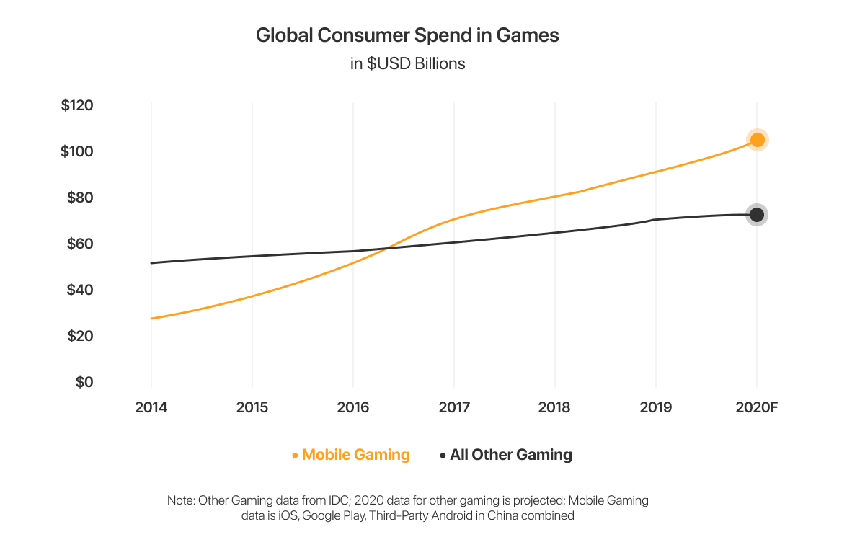
Global Consumer Spend in Games. Source: App Annie
Now that we have determined the amount of revenue generated by gaming apps, let's explore the ways to earn money with an app. The key lies in selecting the most suitable monetization strategy, which typically depends on the genre of the game. For instance, let's consider hyper-casual games that don't require extensive skills. In such cases, the optimal approach for monetization is often through in-app advertisements. This strategy aligns well with the nature of these games, ensuring a seamless and profitable user experience.
Paper.io has successfully implemented a rewarding ad system whereby users are incentivized to watch ads in exchange for benefits such as extra lives or exclusive content. This monetization strategy has proven effective for the app. As a result, Paper.io generates an estimated revenue of $5,000 per month. This approach not only provides value to users but also serves as a sustainable source of income for the app's developers.
If the mobile game development services require a more robust set of skills and have higher engagement rates, in-app purchases work best, so this strategy is implemented as the main, but not the only, source of mobile app income. How much money can you make from an app like Paper.io? Among the games using this strategy, there are huge apps like Tencent’s PUBG Mobile, which made about $1.3 billion in H1 2020, and Honor of Kings, which earned $1 billion.
When it comes to mobile game development services that demand advanced skills and boast higher user engagement rates, in-app purchases prove to be the most effective monetization strategy. While this strategy serves as the primary income source, it may not be the sole revenue generator for the app. Let’s look at how much money can you make from an app based on well-known examples.
To understand the potential earnings of an app like Paper.io, it's helpful to examine the success of other games utilizing this strategy. For instance, Tencent's PUBG Mobile amassed approximately $9 billion in revenue, while Honor of Kings earned a staggering $10 billion. Although these games are free to download, users need to make in-app purchases to make substantial progress, and acquire character upgrades, additional items, required commodities, and more.
While individual purchases may seem reasonable, it's crucial to consider the vast audience size of these games, with around 100 million active users. Each user contributes by making various payments to achieve success or obtain desired in-game items. Collectively, this user base and their spending behavior demonstrate the impressive revenue potential achievable through in-app purchases.
Entertainment Apps
It's undeniable that home isolation has brought about significant changes in our lives, particularly in how we seek entertainment. A notable shift has occurred from traditional cable TV to streaming services, which offer fast distribution and highly personalized content. Cable TV is undeniably losing ground to the growing popularity of streaming services. The COVID-19 pandemic has undoubtedly impacted the entertainment industry, but it has also spurred significant growth and advancement for streaming apps. How much money can you make from developing an app for streaming?
Regarding the potential earnings from developing a streaming app, the figures can vary greatly depending on several factors, such as user base, monetization strategies, and market competition. Successful streaming apps like Netflix and Disney+ have demonstrated substantial revenue-generating capabilities. For instance, Netflix reported revenue of $31.6b in 2022. However, it's important to note that the earnings potential of a streaming app hinges on a number of variables, including the quality of content, user engagement, pricing models, and effective monetization strategies employed by the app.
When it comes to the top-grossing entertainment apps, the answer is relatively straightforward. YouTube and TikTok take the lead in this category. These platforms have achieved remarkable success by implementing distinct monetization strategies while maintaining their dominance in the niche. Despite their differences, both apps continue to thrive and remain at the forefront of the industry.
In 2022, YouTube achieved an impressive global revenue of $29.24b, despite the majority of its content remaining free. The key to its success lies in a combination of in-app advertisements and ad-free subscription options. While the subscription price is reasonable, YouTube's massive audience of 2 billion users contributes significantly to its revenue generation.
On the other hand, TikTok follows a different approach, combining both advertisements and in-app purchases. Users have the option to purchase virtual currency, known as "cons," which can be used to send virtual gifts to content creators. TikTok has found success with its creative business model, generating $9.4 billion in income by 2022. This demonstrates the platform's ability to monetize user engagement and interactions effectively.
In the realm of entertainment apps, video and audio streaming platforms hold immense popularity. These apps, such as Netflix and Pandora, primarily offer free content to users but also provide subscription options and incorporate advertisements. As a result, these platforms generate substantial monthly revenues, with Netflix earning approximately $18 million in June 2023 and Pandora bringing in around $8m. This exemplifies the significant financial success achieved by these streaming apps through a combination of subscription models and advertising strategies.
Health and Fitness Apps
At-home fitness apps set a new record after the lockdown outbreak, so the revenue growth was truly remarkable. Just one example for your interest - in Q2 2020, Peloton’s quarterly revenue grew 172% year over year. So the income was bigger than the expected ones almost 4 times. It is clear that home fitness apps will continue growing and getting more and more profitable.
The growth of the home fitness app market is an expected and well-prognoses matter because, as the dynamics show, in 2021 and 2022, companies will adopt remote work strategies, and mobile habits will continue to change. The figures provided by Reports and Data clearly show that the expected growth of the mobile app market is expected to reach $14.64 billion by 2027
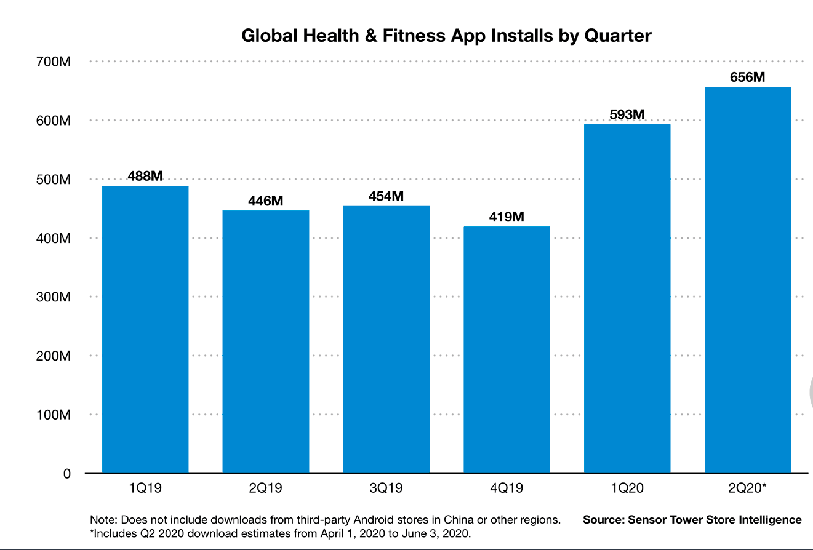
Global Health & Fitness App Installs. Source: Sensor Tower
Strava is one of the leaders in the industry, and the estimated amount people spend monthly is about $2 million. Calm is another example of a success story. This meditation app has $6 million in gross revenue per month. The apps work on a subscription model, so the users can unlock some additional features after the subscription plan is paid. The in-app purchases are also available in case of users decide to get some additional services related to meditation and healthcare.
Sweat is another example of what new developers can implement and what the audience really wants to get from the app. When the app was first released, its user base was really stunning. Now its revenue is estimated at $100 million yearly. The Bikini Body Guide (BBG) was created, so online fans slowly but steadily became paying customers with immense purchasing potential. The goal was simple, and it was reached with the help of providing users with 28-minute workouts, yoga videos, and meal plans on a monthly or yearly basis. So yes, here they had used a subscription-based model as well, and it really wrecked out.
Educational Apps
But is it true that the rest of the app categories can’t generate substantial revenue? Well, not quite like that. Other categories can still generate a lot, and educational apps are at the top of this list. They are not only the game changers nowadays, they can be the way for you to have a good impact.
Babbel is just one example of a lucrative language-learning app. It offers short lessons crafted by native speakers and language experts. The app is focused on conversations, not on vocabulary or grammar. There are no in-app ads, just a subscription to get access to the additional content. So the users are not distracted from learning, getting 100% out of the app. Such a wise strategy resulted in $115 million in revenue per year.
Related: How to build an eLearning App
There’s one fact worth mentioning, and it lies on the surface - all top apps use subscription models. They actively encourage users to switch to Premium for new features and additional benefits. As it was mentioned, a strategy like that is the gold mine for apps, providing dynamic content to the users.
Is it Profitable to Develop Apps for Other Smart Devices?
Apps are implemented into smart devices, and nowadays, these apps-inside-apps are a common practice. The wearable technology market is growing, reaching $50 billion in revenue in 2019. These immense figures became real because of IoT spreading across the globe. The wellness and lifecare industries are the main areas where wearable devices are used at the moment. The reason is simple - they provide real-time access to the user]’s health condition and metrics, for example, data on blood pressure, glucose levels, quality and quantity of sleep, and steps taken.
There are a couple of segments in this market - eyewear, headwear, bodywear, wristwear, footwear, and other wear. It is predicted that eyewear and headwear will thrive in the next couple of years. So if this area sounds interesting to you, it’s a wise decision to have a closer look at these segments.
Smart TVs are another kind of intelligent device whose popularity is constantly growing. It all works like that: the number of streaming services and users involved is growing, so the number of smart TVs and related apps is growing too. The Smart TV market is going to be worth $298 billion in 5 years, the reports say. Netflix, Hulu, and YouTube already have a huge user base, and they are indeed used in Smart TVs. It’s absolutely clear that their revenue will be growing too.
Another point to consider is AI's rapid development and growth. Ai made such services as Alexa and Google Assistant real. They can do whatever you want them to, including reading aloud. So in 5 years, the intelligent speaker market can hit $35.5 billion in revenue.
All these facts show: that apps are not tailored to smartphones only. They can be a part of absolutely anything, so keep in mind wearable devices if the segment seems appealing. Think outside of the box and get the best solution out of the list.
Key Takeaways
Now that you have coped with the whole article, it’s time, to sum up - there’s no definite answer to how to monetize an app idea and how much money an app can generate. Still, you may use the information regarding various app categories as the basis for your calculations.. For example, when we talk about gaming apps, their potential is close to becoming billion-dollar earners. Less complex apps and the smart device market have immense potential as well.
As it was stated in the research we have used for this article, op apps use a subscription-based monetization strategy combined with other sources of revenue. So remember the world around you and the possibilities the world around provides.
The possibilities of making money with the mobile app you have developed are incredible. To develop a perfect monetization strategy, one should conduct profound research on platform differences, monetization strategies and their combinations, and other matters.
Our main mission is to help your business grow and prosper with our custom mobile app development expertise. Contact us to get a free consultation from our analytics so we can help you to choose the best niche, app type, and monetization strategy.

Areas of responsibility - brand and growth marketing. Strongly believes that software development is an art and marketing is not just about sales but about sharing your passion. Her educational background in the field of business and marketing allows her to create expert content and help others to grow and expand knowledge.